
Since the Hamas-led attack on Israel in October 2023, the Red Sea has experienced a surge in military tensions. The “Red Sea Crisis” began after a military movement within Yemen, named the Houthi movement, launched a series of attacks against commercial ships sailing near the Yemeni coast. This movement seemingly poses a message against the Israeli government, as they are targeting ships which are Israeli-owned, but it could also be linked to the American-British aggressions that have continuously haunted the Middle East. Since the start of the conflict, two ships have been hijacked by the Houthis, and at least ten ships have been damaged by the attacks. As of now, the conflict is still ongoing with no resolution in sight as stated by experts and officials.
Background – The Houthi Movement
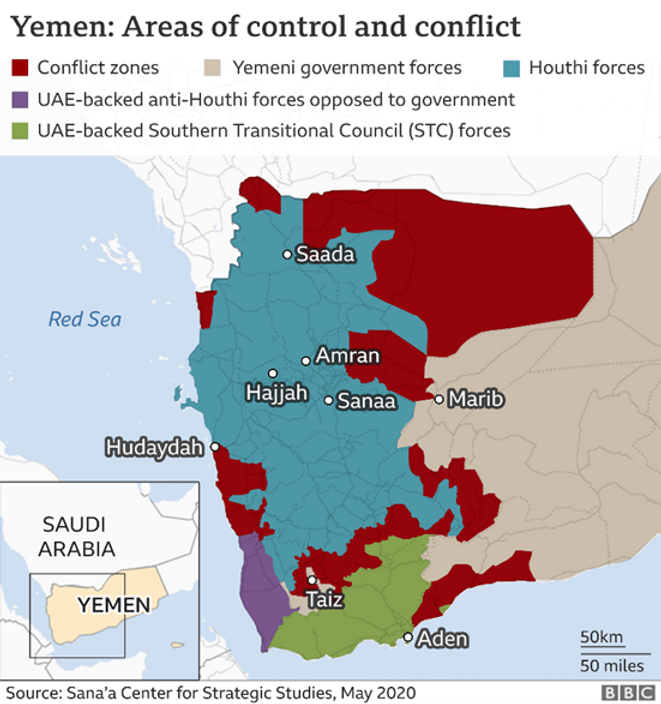
The Houthi movement, a supposedly Iran-backed Zaydi Shia Islamist militant organization, has wielded de facto control over parts of Yemen since its takeover of the capital city of Sanaa in 2014 (See Figure 1). Despite this, the international community continues to recognize the anti-Houthi Presidential Leadership Council as Yemen’s legitimate government. The ensuing conflict escalated into a civil war, leading to millions of internal displacements and a Saudi-led coalition imposing a blockade on Yemen. Consequently, Yemen has witnessed one of the worst famines globally since 2017. In the wake of the Israel–Hamas war ignited by the Hamas-led attack on Israel in October 2023, various Iran-backed militant factions, including the Houthis, expressed solidarity with the Palestinians and issued threats against Israel. Houthi leader Abdul-Malik al-Houthi cautioned the United States against intervening in favour of Israel, vowing retaliation through drone and missile strikes. To cease their attacks in the Red Sea, the Houthis demanded a ceasefire in the Israel–Gaza conflict and an end to the Israeli blockade of the Gaza Strip.
The weaponry employed by Houthi militants, as identified by Armament Research Services, predominantly comprises arms of Russian, Chinese, or Iranian origin, including surface-to-surface missiles, artillery rockets, loitering munitions, and unmanned aerial vehicles (UAVs). Notably, their arsenal includes missiles and UAVs capable of reaching Israel from Yemen, such as the Toufan, cruise missiles from the Iranian Soumar family, the Quds-2 missile, and drones like the Samad-3, Samad-4, and Wa’id drones, each equipped with extensive strike ranges.
Figure 1
Impacts
The Houthi militants’ aggressive actions extend beyond Yemen’s borders, particularly manifesting in the Red Sea, notably the Bab-el-Mandeb strait—a vital chokepoint in the global economy, serving as the Southern gateway to the Suez Canal of Egypt. Their assaults on merchant vessels have disrupted international maritime trade, compelling hundreds of commercial ships to divert their routes around South Africa to evade Houthi attacks. The Suez Canal stands as a pivotal artery in global maritime trade, facilitating the passage of approximately 19,000 ships annually. Renowned for its strategic significance, the canal serves as a vital conduit for the transportation of goods, particularly fossil fuels, and commodities between Asia and Europe.
The commercial shipping landscape, particularly in Israel, has been severely affected by the Houthi attacks, with the port of Eilat experiencing a near-complete stop of commercial traffic. Vessels destined for Israel, as well as those passing through the region, have resorted to circumnavigating Africa—a detour that elongates the journey by approximately three weeks and escalates operational expenses significantly. Moreover, the surge in insurance costs for ships traversing the Red Sea further increases the financial burden on commercial operators. Israeli ships, in particular, have witnessed a staggering 250% increase in insurance premiums, while others have encountered overwhelming hurdles in securing enough coverage.
Several major shipping companies, including MSC, Maersk, CMA CGM, COSCO, Hapag-Lloyd, and Evergreen Marine Corporation, suspended ship traffic through the Red Sea in response to the attacks. Additionally, BP, a prominent British multinational oil and gas company, halted all shipments via the Red Sea on December 18. Maersk, holding a significant market share in global container shipping, initially resumed Red Sea operations on December 25 following Operation Prosperity Guardian but paused again after the attacks on Maersk Guangzhou. Moreover, Tesla announced a suspension of production at its Grünheide factory in Europe for two weeks starting January 29 due to supply chain disruptions caused by the Houthi attacks. Similarly, Volvo Cars halted production at its Ghent plant, while the company Shell also announced a transit hold through the Red Sea.
Current events
On January 25, 2024, Abdul-Malik al-Houthi asserted that the Houthi’s primary objective was to support the Palestinians, emphasizing that their operations would cease once food and medicine reached all of Gaza. On January 30, Houthi commander Mohamed al-Atifi declared the Houthi’s readiness for a prolonged confrontation against perceived oppressive forces. By February 4, 2024, a Houthi spokesperson criticized Washington for dismissing the severity of the situation in Gaza, suggesting a disregard for the interconnectedness between events in the Red Sea and Gaza.
Operation Prosperity Guardian, an American-led military coalition, was initiated in response to escalating tensions in the Red Sea. Despite the US Navy’s interception of Houthi rockets and missiles, it refrained from direct retaliation against the assailants. In December 2023, following consultations with allies, the US established a multilateral naval task force aimed at safeguarding commercial vessels in the Bab-el-Mandeb Strait and the Gulf of Aden. Codenamed Operation Prosperity Guardian, the operation commenced on December 23, 2023, resembling previous projects such as protecting vessels during the “Tanker War” in the 1980s and ongoing maritime security operations in the Persian Gulf and the Strait of Hormuz. While drawing parallels with past successful campaigns against Somali pirates, Operation Prosperity Guardian faces unique challenges given the Houthi’s backing from Iran and access to advanced equipment, including helicopters, drones, missiles, and speedboats.
Conclusion
In the three months since the Red Sea disruptions began; the situation appears to be heading into a more intense and broadening confrontation with seafarers. The vessels that still operate in the Red Sea are more at risk now than when the Houthi Movement first announced its aggressive policy. The conflict has no end in sight yet – the Houthis will fight until “the conflict in Palestine is resolved”, meaning that Israel should cease its attacks on occupied Palestine. As the Red Sea Crisis is directly related to the Israel-Palestine conflict, it is important to be aware of the events that started such a global response, and whether movements like the Houthi one are effective in stopping the conflict.
 Home | Centuria Study Association
Leave a comment