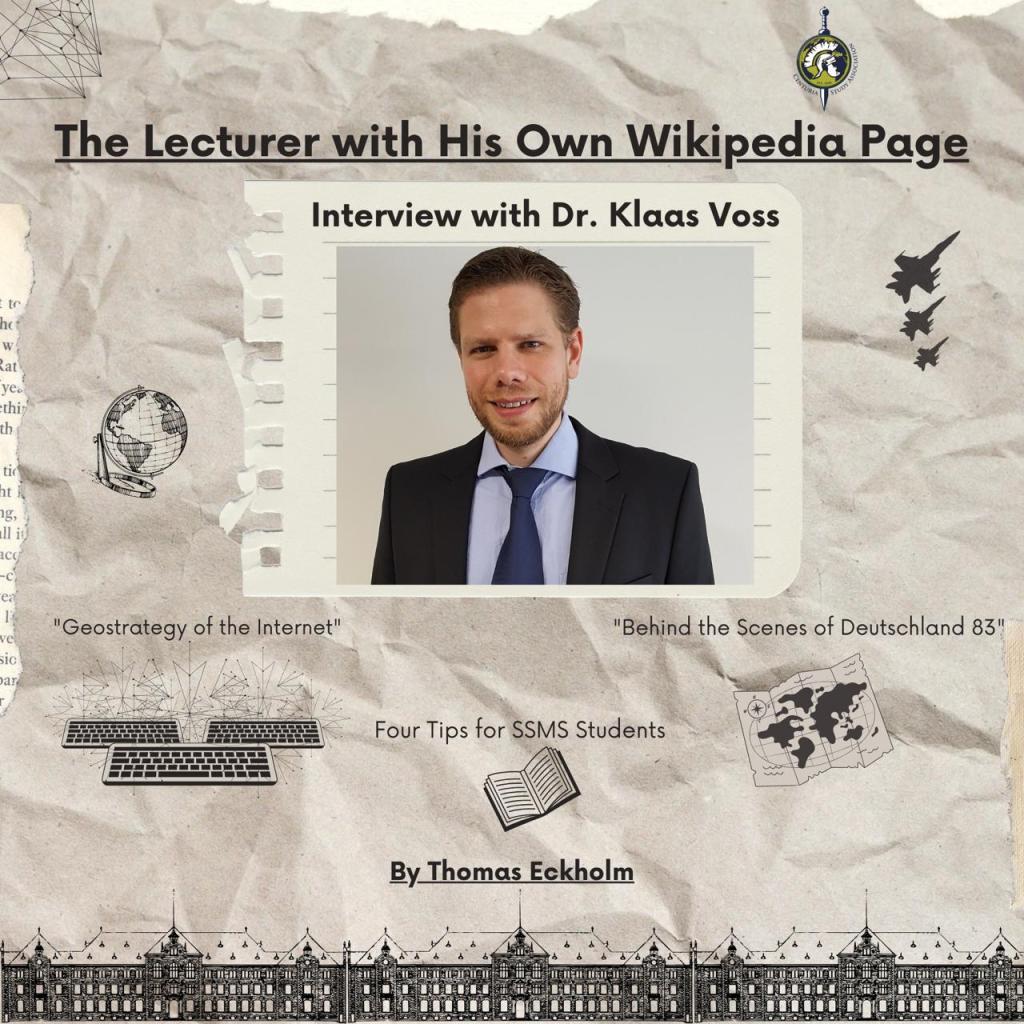
Interview with Dr. Klaas Voss
By Thomas Eckholm
In a recent conversation with Dr. Klaas Voss, historian and SSMS lecturer, we delved into the inspirations behind his career choices, how he helped television producers to ensure the accuracy of historical details of the popular TV show Deutschland 83, how he met Stanislav Petrov, the person whose decision averted a potential nuclear crisis, and more.
The Path to History
When asked about his academic background at Hamburg University, Dr. Voss shared that his initial interest in history came from a deep fascination with the colourful details that often go unnoticed. “I was always drawn to the obscure things, the details that weren’t common knowledge,” he said. However, Dr Voss’ journey wasn’t only driven by passion, his choice of subject also aligned with his own practical goal which at the time was journalism. “At the time, many inspiring journalists pursued degrees in history and political science,“ Dr Voss said. While internships in public television led him to reconsider his journalistic career, they shaped his academic path.
Behind the Scenes of Deutschland 83 TV Series
Dr Voss’ role as a historical consultant for the popular TV series Deutschland 83 began unexpectedly, after giving a public talk on the Cold War nuclear crisis surrounding the NATO exercise Able Archer. “One of the producers attended my session, and that’s how it started,” he explained. What began as a casual meeting soon turned into a 2-season collaboration, where Dr Voss provided his expertise to ensure the historical accuracy of the show.
However, he discovered that authenticity wasn’t always the priority in television. “You also have to look at this from the perspective of storytelling. Not everything that you find interesting as a historian is interesting from a storytelling perspective.” Dr Voss explained. Multiple factors should be taken into consideration, like character development and the actual audience. “A lot of authors and researchers should ask themselves more often, who am I writing for, who is my audience?” He said.
- Able Archer was a 1983 NATO military exercise that simulated a nuclear conflict, which the Soviet Union mistakenly believed might be a real nuclear attack, escalating Cold War tensions (DiCicco, 2011, pp. 253-273)
New perspective on mercenaries
In his doctoral thesis, Dr. Klaas Voss chose to explore a topic that many considered impossible: The role of mercenaries in U.S. covert operations during the Cold War. “There was this kind of misguided idea that during the 20th century, mercenaries did not really play a big role, but in fact they were tremendously useful during the Cold War in the context of covert interventions and clandestine operations,“ Dr. Voss explained.
Dr. Voss’ research took him on a 6-month journey across the United States, from dusty archives to presidential libraries, in search of material for such a secretive subject. Almost everybody he talked to told him that it would be impossible to research because of the secrecy, but eventually, his thesis debunked the myth that mercenaries were a new phenomenon and highlighted their significant role during the Cold War.
Geostrategy of the Internet
When asked about a potential topic that he could research no matter the costs or resources, Dr. Voss mentioned an interesting concept of the “geostrategy of the internet”. He proposed an idea that connects the gap between the physical and the virtual world. The underlying premise is that the Internet’s physical infrastructure such as the deep-sea cables, data centers and server hubs is profoundly vulnerable to conventional attacks and territorial domination, similar to classic geopolitical objectives, such as geographical choke points or stepping stones. This puts a different spin on the concepts of hybrid and cyber warfare. “I don’t think this has been explored enough,” he said.
The Unexpected encounter
While working on a documentary, Dr. Klaas Voos had a rare opportunity to meet Stanislav Petrov, the man who helped to avert a potential nuclear war in 1983. “I even have a photo to prove it”, he explained. “He came to the interview dressed as if he had just been doing gardening work, but he was very modest,” Dr. Voss recalls. He said he was one of the nicest people that he had met. “Whether it was because he didn’t acknowledge his historical significance or due to the fact that he thought anybody would have done what he did, but we will never know,” he said.
- Stanislav Petrov was a duty officer whose job was to register apparent enemy missile launches, but he decided not to report them to his superiors and instead dismissed them as a false alarm. The protocol for the Soviet military would have been to retaliate with a nuclear attack of its own. Ultimately, this decision may have saved the world from a nuclear disaster (Aksenov, 2013, p. 1).
Four Tips for SSMS Students from Dr. Klaas Voss
As we concluded the interview, Dr. Klaas Voss shared some important advice for all the SSMS students. His words carry valuable lessons about navigating both academic and personal challenges.
Here are the four tips he offered:
- Never try to eat soup with a knife, because you can always slurp it from the bowl.
- When choosing between the devil and the blue sea, choose the sea – unless you can’t swim, then you have to appease the devil.
- Never make an enemy if you can make a friend, but don’t make a friend if what you really need is an enemy.
- If you have to apply a tourniquet for catastrophic bleeding, don’t forget to write down the time.
His words to students are simple but powerful: Stay curious, adapt, and don’t be afraid to take risks. Most importantly, find the right tool for the job, and sometimes, that means just slurping the soup!
Reference list:
DiCicco, J. (2011). Fear, Loathing, and Cracks in Reagan’s Mirror Images: Able Archer 83 and an American First Step toward Rapprochement in the Cold War. JSTOR. https://www.jstor.org/stable/24909797
Aksenov, P. (2013). Stanislav Petrov: The man who may have saved the world. BBC News. https://www.bbc.com/news/world-europe-24280831
 Home | Centuria Study Association
Leave a comment