
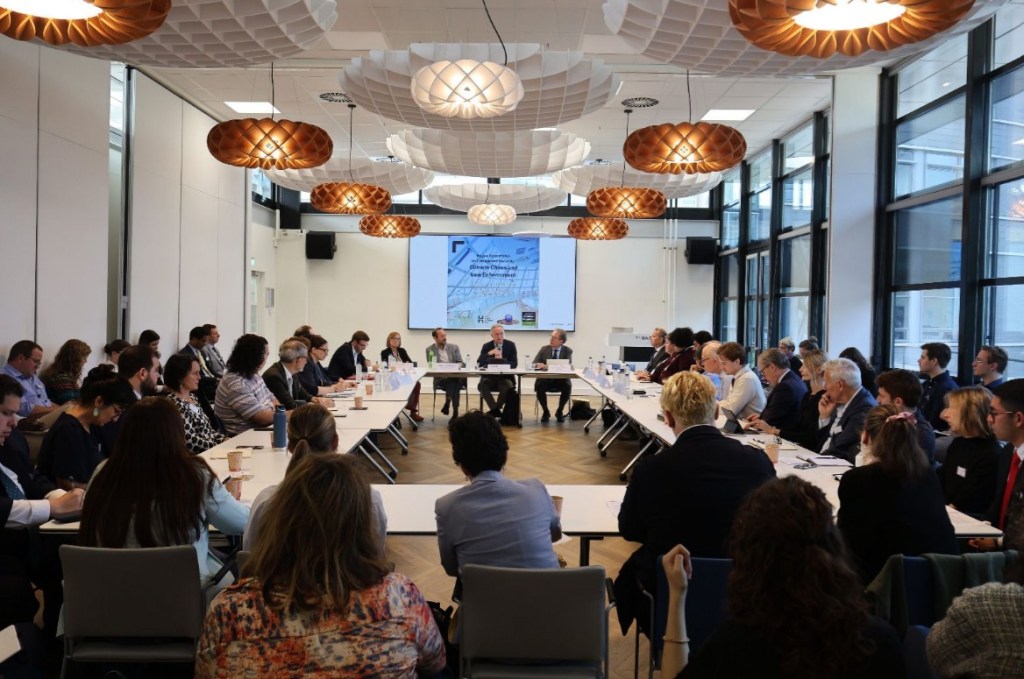
Discussions led by The Hague Roundtable on Climate and Security
By Clara Tonecker
Climate security is one of the fastest growing and at the same time most underestimated fields in safety and security. After their studies, SSMS students will have the opportunity to specialize in disaster management, climate risk management, search and rescue operations, disaster research or environmental crimes, to name only a few. The topic of the intersection of climate change and law enforcement was adopted for the 16th meeting of The Hague Roundtable on Climate and Security, hosted at The Hague University of Applied Sciences on 18th September 2024 and co-organized by SSMS lecturer Dr. Anna Matczak. Among the attendees of this event were representatives of embassies, UN agencies, law enforcement and various NGOs. This article aims to explain how police work is affected by climate change, cover main arguments and ideas brought up during the conference, and highlight the growing necessity of safety and security professionals pursuing a career in this exciting field.
Careers in climate safety & security
Climate change and environmental degradation has an increasing impact on the security field (European Commission, 2023). Climate change is considered a risk multiplier, meaning it exacerbates those risks and insecurities that manifest as the root causes of conflict. Violent conflict can be caused, among other things, by competition over scarce resources, food and water insecurity and climate-related migration (Läderach et al., 2023). Safety and security professionals will be needed to coordinate emergency services during extreme-weather events such as floods, wildfires and earthquakes; to evacuate disaster victims from affected areas and save lives; to advise businesses on how to mitigate climate-related risks; to help in the mediation process between groups or countries in conflict; to lead a humanitarian program improving climate, water and food security in an affected area; to investigate and prosecute crimes such as wildlife trafficking; and much more. For this reason, the four SSMS students Lisa Braune, Anniek Mulder, Diana Ţigănus and Clara Tonecker were given the unique opportunity to participate in this conference and meet professionals in this field. The conference narrowed its focus on the impact of climate change on law enforcement, for instance, response to extreme-weather events, climate protests and environmental crimes.
3 insights of the Dutch police
The conference began with a short introduction to the topic. Climate change mainly leads to increasing shortages of resources, which further leads to global competition and conflict. It is a breeding ground for extremism, migration and organized crime. In 2023, natural disasters such as wildfires, hurricanes, droughts and floods resulted in more than $1 billion worth of damages worldwide. Therefore, it is important to include climate change as an economic factor in risk assessments. The Dutch police named multiple problems deriving from climate change. Firstly, more crimes are reported on warm nights, discovered through a cooperation with the National Meteorological Institute. Secondly, police uniforms need to be adjusted to heatwaves, which could be done through cooling vests in the future. Thirdly, during extreme-weather events more police units from different regions are deployed to the affected region, meaning in their original regions, there is a lack of police units able to investigate crimes.
The discrepancy between ‘enforcing the law’ and ‘serving society’
A major focus of the conference was climate-related public disorder, namely how police should deal with environmental protesters. The main goal was to find common ground, a win-win solution benefitting both the police and climate activists. The main problem is heightened tension between civil society and the police, resulting from climate protests such as the blockade of the highway A12 in The Hague, where the police had to remove protesters. One participant argued that in the case of climate demonstrations, ‘enforcing the law’ is not the same as ‘serving society’. Remaining neutral means letting a system prevail that will endanger society more in the future. Furthermore, he argued that citizens have a moral obligation to remind governments of their duty, which, as another participant added, can take the form of civil disobedience if legal means have not captured their attention. A counterargument was that ‘well-intentioned’ climate protests can be exploited and infiltrated by individuals or groups looking to cause social disruption. A participant of the judicial field added that prosecutors have to remain neutral regarding the reason of the protest, meaning individuals are not arrested because they are climate activists but because they broke the law by obstructing highways or airports. Lastly, it was noted that police and civil society must find common ground because the human future depends on it. In that case, it should be considered if win-win situations can be found or if they have yet to be created.
$281 billion
The last major focus of the conference was the different types of environmental crimes. Environmental crimes generate $281 billion annually, making it the third largest criminal activity globally. Crimes such as wildlife trafficking, illegal fishing, illegal logging and illegal extraction of raw materials also finance other types of transnational organized crime such as human or drug trafficking and terrorist activities (Yansura, 2024). However, law enforcement faces multiple challenges while tackling environmental crimes such as a lack of resources and specialized knowledge, the perception of environmental crimes as ‘victimless’, and improving criminal tactics.
Climate change is not only impacting law enforcement but the entire security sector. As mentioned above, SSMS students will have countless options to pursue a career in the field of climate security. If this topic has captured your interest, I would advise to keep an eye on future meetings and publications of The Hague Roundtable on Climate and Security.
Reference list:
All of the non-referenced information in this article derives from presentation slides and notes taken during the conference.
- European Commission. (2023, June 28). EU proposes comprehensive new outlook on threats of climate change and environmental degradation on peace, security and defence. https://ec.europa.eu/commission/presscorner/detail/en/ip_23_3492
- Läderach, P., Schapendonk, F., Shirsath, P., Amarnath, G., Prager, S. D., Gummadi, S., Kramer, B., Govind, A. & Pacillo, G. (2023). The Climate–Security Nexus: Securing Resilient Livelihoods through Early Warning Systems and Adaptive Safety Nets. In B. Campbell, P. Thornton, A. M. Loboguerrero, D. Dinesh, & A. Nowak (Eds.), Transforming Food Systems Under Climate Change through Innovation (pp. 63–74). Cambridge University Press. https://doi.org/10.1017/9781009227216.007
- Wallner, C. (2023). Eco-Extremism. Quarterly Research Journal. European Commission. https://home-affairs.ec.europa.eu/document/download/0a703013-0414-4979-97e5-12e3e7c4c494_en
- Yansura, J. (2024). Environmental Crimes Pose Unique Illicit Finance Challenges [Policy Brief]. FACT Coalition. https://thefactcoalition.org/wp-content/uploads/2024/08/Environmental-Crimes-Policy-Brief-FACT-ENG.pdf
We always obtain written permission to publish specified information from the organizing or presenting parties of the event mentioned in the article. However, if the organizing or presenting parties wishes certain information or pictures removed from the article, please send an email to centuria-sa@hhs.nl .
While we are transparent about all sources used in this article and double-checked all the given information, we make no claims about its completeness, accuracy or reliability. If you notice a mistake or misleading phrasing, please send an email to centuria-sa@hhs.nl .
 Home | Centuria Study Association
Leave a comment