
A Comparative Analysis of Prison Governance,
Oversight and Informal Power Structures
A Georgia Excursion Report by Dani Piar
Abstract
This report includes a comparative analysis of Georgia’s and the Netherlands’ prison regimes, with reference to Bonaire (Justitiële Inrichting Caribisch Nederland, JICN). It examines how detention policies in these two settings are influenced by human rights standards, institutional trust, and prison governance. With a mixed-method design, the study includes secondary literature, field observations, informal interviews in Tbilisi, and my professional experience working within the Dutch custodial system. The study is based on global legal frameworks, namely the European Prison Rules (EPR) and the UN Nelson Mandela Rules.
Studies reveal that Georgia’s penitentiary system, despite post-2012 reforms, continues to struggle with institutional weakness, restricted access to healthcare, and the persistence of criminal subcultures such as the ‘thieves in law’. Conversely, the Dutch approach implemented in Bonaire gives a formal and transparent policy of corrections grounded in oversight, professionalization, and rehabilitation. Institutions such as CvT (internal control) and Gedeco (council of prisoner representation) promote institutional trust and limit informal power structures.
The report also considers Georgia’s aspirations for EU membership and the need to align its prison policy with European human rights standards. It concludes that real progress in detention conditions is not simply a matter of legislative reform but involves cultural change, investment in professional capacity, and the building of monitoring systems. By raising awareness of various models, this report contributes to broader discussions concerning penal reform, human dignity, and the implementation of human rights in custodial settings.
Acknowledgements
I would like to express my sincere thanks to the individuals I spoke with during my visit to Tbilisi, whose informal insights added depth and real-world perspective to this research. I am also grateful to the staff and professionals at the Justitiële Inrichting Caribisch Nederland (JICN) on Bonaire, where I gained direct experience in correctional work.
Special thanks go to Dr. Menandro Abanes and Centuria for organizing this research trip. Their initiative made the fieldwork component of this project possible. I also wish to express my gratitude to The Hague University of Applied Sciences (THUAS) for providing the academic foundation and environment that allowed this comparative research to take shape.
Abbreviations
CPT European Committee for the Prevention of Torture and Inhuman or Degrading Treatment or Punishment
CvT Commissie van Toezicht (Supervisory Committee, internal prison oversight body in the Netherlands)
DJI Dienst Justitiële Inrichtingen (Dutch Custodial Institutions Agency)
EPR European Prison Rules
EU European Union
JICN Justitiële Inrichting Caribisch Nederland (Correctional Institution of Caribbean Netherlands)
NPM National Preventive Mechanism
OHCHR Office of the High Commissioner for Human Rights (United Nations)
PIW’er Penitentiair Inrichtingswerker (Dutch Correctional Officer)
UN United Nations
UNODC United Nations Office on Drugs and Crime
Introduction
Prisons are more than just spaces for confinement; they are symbols of a society’s approach to justice, human rights, and power. As Frantz Fanon (1963) argued, postcolonial institutions will tend to reproduce the colonizer’s discipline, even under the guise of reform. No institution shows this contradiction more clearly than prison systems, where efforts to modernize the buildings or professionalize the officers can remain insufficient when trying to bring change. The European Prison Rules (EPR) gives guidelines for implementing human rights in such regimes by putting an emphasis on dignity, healthcare, oversight, and rehabilitation (Council of Europe, 2020).
This research report contains a comparative analysis of prison systems in Bonaire and Georgia. Although Bonaire is not a member of the Council of Europe and is not legally bound by the European Prison Rules (EPR), the Dutch government still applies these standards to its overseas territories (Raad voor de Rechtshandhaving, 2014). Georgia, in contrast, is subject to European Committee for the Prevention of Torture and Inhuman or Degrading Treatment or Punishment (CPT) supervision and has made formal commitments to transition towards European human rights standards, particularly as it is a candidate country for membership in the EU.
This research report uses a mixed qualitative method, using field research, informal interviews, direct experience working within JICN on Bonaire, and desk-based secondary research. Informal interviews were held on a visit to Tbilisi with local citizens and representatives of local organizations, which gave firsthand perspectives on the Georgian prison system. Some of the interviews were not formally documented at the time due to their spontaneous nature. While some interviews were not formally documented, they still provide valuable insights into the public’s perception of the Georgian prison system.
For example, one respondent explained how a relative had been refused medical treatment while in detention. This account is consistent with evidence in recent Human Rights Watch and United Nations reports of systemic failures in healthcare delivery in Georgian prisons. Such accounts, though sketchy, serve to reinforce the ongoing need to document human rights concerns in detention facilities. These stories were triangulated against verified secondary evidence, such as publications of the CPT, reports of the Georgian Public Defender (NPM), and of the Council of Europe, for strict analysis and objectivity.
The main question is not whether policy guidelines exist, but whether they support institutional trust, protect vulnerable groups, and change the internal power relations of detention. Finally, the analysis looks into whether human rights norms are being implemented as superficial formalities or as part of a deeper shift toward more humane and accountable prison systems.
Historical Background of Georgian Prisons
Prison Conditions and International Human Rights Standards
Prison conditions should align with human rights because they have a direct impact on the health of prisoners. The United Nations Standard Minimum Rules for the Treatment of Prisoners are also called the Nelson Mandela Rules. According to Rule 24, prisoners should receive healthcare that is equivalent to that available in the community, and such care must be provided without discrimination based on legal status (United Nations Office on Drugs and Crime, 2015, p. 8).
Similarly, the Council of Europe’s European Prison Rules (EPR) highlights that it is the duty of the states to safeguard the dignity and well-being of prisoners. This includes accommodation, nutrition, access to healthcare, and the prevention of torture or degrading treatments Council of Europe, 2020, Rules 18–26). These principles are relevant in the Georgian context, where there are shortcomings in healthcare and sanitation, which has been documented by independent national organizations such as the European Anti-Torture Committee (CPT).
Legacy of Abuse
In the past, Georgia has faced significant challenges in keeping humane conditions within its prison system. Many reports by human rights organizations during 2002-2010 show that there was mistreatment, limited access to necessities and high infectious diseases among prisoners. Furthermore, the country’s prison population had tripled, leading to overcrowding, poor sanitation, and scarce medical care.
“We were shocked by the dramatic overcrowding in the pre-trial detention centers, mainly in the section of adult men. It is hard to describe without emotion the circumstances under which human beings are kept. We described the situation to Georgian officials… and explained that in the European Union it is not permitted to keep even pigs under such conditions.” – Human Rights Watch (2006).
2012 Gldani Torture
On September 18, 2012 videos of torture and sexual assaulting of inmates were leaked from Gldani prison No. 8 in Tbilisi. This footage showed how prisoners were being beaten, sexually assaulted, and subjected to severe humiliation by prison guards (Public Defender of Georgia, 2013, p. 21). This led to mass protests across the country and damage to Georgia’s international reputation and would later influence the outcome of the parliamentary election later that year, introducing the currently governing political party Georgian Dream, founded by billionaire Bidzina Ivanishvili (Libcom.org. 2012, September 21).
You’re standing there completely naked as they beat you—not because you’ve done something wrong or somehow misbehaved, but simply because they want to do it.
—Mikheil, 59
He stood up and approached me. I was facing the wall, and he gave me a blow to the kidneys with a truncheon. Then he kicked me between my legs. I needed an operation later, and my left testicle was removed. My kidneys are still damaged—they are too low—and I no longer have any teeth left in my mouth.
—Shota, 57
There were lots of them; I can’t say how many of them were beating me, how many fists were flying at me. Then I fell, and the only thing I managed to do was protect my face with my hands.
—Genrikh, 44
(Jeiranashvili & Slade, 2015, para 1-3)
Post-2012 prison reforms
The newly elected government introduced prison reforms such as new prison governors and ministers helping with implementing new anti-torture measures (Ombudsman of Georgia, 2023, p. 29). Furthermore, in 2013, the Georgian Dream government passed an amnesty law, resulting in the release of 8044 prisoners, which reduced the country’s prison population considerably (Civil Georgia, 2013, p. 48). This led the United Nations Office of the High Commissioner for Human (UNCHR) to say that Georgia has made progress, ensuring that prison conditions meet international human rights standards; however, it stil remains a work in progress (Rights [OHCHR], 2023).
However, despite the reforms that have been made, the 2023 Public Defender (Ombudsman) report highlights continuing concerns about overcrowded facilities, weak complaint mechanisms, and inadequate access to healthcare services, and psychiatric care provision. In addition to the concerns, throughout the report, various recommendations were given, including increasing the capacity of independent monitoring bodies, improving detainees’ access to timely and specialized healthcare, and enhancing complaint-handling procedures within penitentiary institutions.
Resurgence of criminal subculture
Despite the institutional reforms introduced after 2012, significant challenges remain within Georgia’s penitentiary system. During field interviews conducted in Tbilisi, one individual suggested that crime had increased following the government change and mass amnesty. One possible explanation is the 2013 release of over 8,000 prisoners (See Figure 1). While the intention was to reduce overcrowding this may have unintentionally increased the crime rates on the outside and made a power vacuum within the correctional environment.
Figure 1
Total Prison Population in Georgia from 2000-2022
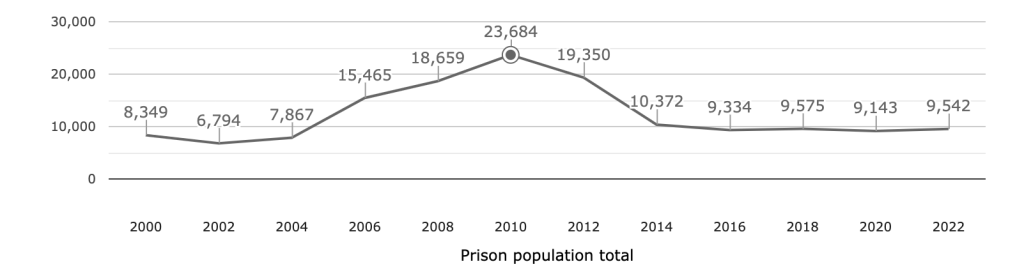
Note. Taken from World Prison Brief, n.d., https://www.prisonstudies.org/country/georgia
This vacuum brought the reappearance of the kanonieri qurdebi (‘thieves in law’), which is a criminal subculture known for its hierarchical control over inmates and informal dispute resolution. According to both interview testimony and secondary sources, mafia figures have regained influence in some facilities. In 2014, for example, it was reported that disturbances in Georgian prisons were mediated and resolved through the intervention of such criminal leaders. (Kupatadze & Slade, 2014, para. 3).
This suggests that there was an institutional weakness, limited staff capacity, and a lack of sustained professionalization that may have created space for the ‘thieves in law’ to re-emerge (Public Defender of Georgia, 2023, pp. 29–31). Addressing this issue requires more than legal reforms; it needs sustained institutional investment, cultural change within prison staff, and active efforts to dismantle criminal influence networks.
The Dutch Model in Practice: Oversight, Trust, and Rehabilitation at JICN Bonaire
The Netherlands is well known for having a structured, transparent, prison governance model that is built on security principles and human rights values. This is not only seen in its national policy but also in how these principles are applied to its overseas municipality Bonaire at Justitiële Inrichting Caribisch Nederland (JICN). Dienst Justitiële Inrichtingen (DJI) is a division of the Ministry of Justice and Security which is responsible for administration, management, and oversight of all correctional facilities in the Netherlands and this includes JICN. DJI puts an emphasis on the professionalization of prison staff, checks and balances within prison operations, and a rehabilitative prison environment.
Furthermore, research confirms that Dutch prisons prioritize respectful staff-prisoner relationships, transparency in rule enforcement, and consistent professional boundaries, which limits informal power rising. According to the Life in Custody Study, Dutch prisoners report positive perceptions of safety and interpersonal treatment, especially in minimum security and extra care regimes. Autonomy, staff respect, and personal dignity are emphasized, even within the constraints of incarceration (Ginneken et al., 2018, pp. 16-18).
Drawing from personal experience as a former prison staff member in Bonaire, I saw how JICN had the same values and principles as other DJI facilities. Since 2013 JICN has implemented a mentorship program where each prisoner gets assigned a PIW’er (correctional officer) as a mentor. The aim of this is to create a better relationship with the detainee and to support them throughout their incarceration.
In addition, prisoners’ progress is regularly documented, creating transparency and accountability for when the Commisie van Toezicht (CvT) (the internal prison oversight body) conducts monitoring visits. JICN also has a Gedeco (gedetineerdencommisie), which is the prisoner’s council that provides detainees with the opportunity to raise concerns or give suggestions directly to the management. Meetings with management are held monthly and this helps to create a culture of open communication instead of criminal subculture. Furthermore, it builds institutional trust (College voor de Rechten van de Mens & Raad voor de Rechtshandhaving, 2019, p. 36).
In short, the Dutch prison model, as applied to Bonaire shows how consistent institutional control, professional training, and external oversight systems can limit the spread of informal hierarchies to form.
Key differences and similarities
While both detention facilities in Georgia and Bonaire are operating within the European legal system, the Georgian and Dutch penal system differs significantly regarding institutional culture, oversight, and prisoner-staff relations.
The Gldani prison No.8 scandal and the re-emergence of the ‘thieves in law’ show that there is institutional weakness and a failure to fully reform Georgia’s prison system. While there are formal oversight institutions such as the Public Defender and CPT overseeing the trajectory of prison systems, they still struggle with effectiveness and inmate trust. This gap is filled in by the informal hierarchy where the institution is lacking.
Looking at the Dutch prison model adopted at JICN in Bonaire, it is built on institutional trust and consistent professionalism. From my own experience working at JICN, I saw how regular staff training, open communication, and structured supervision created a clear framework for accountability. In addition, the presence of CvT gives detainees a reliable way to address their concerns. The mentorship program also helps create better staff-detainee relationships by giving personal support to them. These elements included within the Dutch prison system help reduce the risk of informal hierarchies forming within this environment.
Another significant difference is the role of the prisoner representation. In Bonaire elected detainees participate in this council. This gives detainees a voice within the institution because they hold regular meetings with the management staff every month. No comparable structure exists in Georgia, where detainees have limited influence on their environment which leads them to rely on unofficial powers structure to resolve their disputes.
Lastly, the biggest difference lies in the way institutional trust and informal governance are connected. In the Georgian prison system, where accountability is inconsistent and communication channels are weak, criminal subcultures are more likely to emerge. In contrast, the Dutch prison system demonstrates how fairness, oversight, and active prisoner-staff engagement can reinforce “rule of law” values and prevent the need for informal authority structures within prison walls.
Ultimately, the key distinction lies in the relationship between institutional trust and informal governance. In systems like Georgia’s where accountability is inconsistent, and communication channels are weak, criminal subcultures are more likely to emerge. In contrast, the Dutch approach demonstrates how fairness, oversight, and active prisoner-staff engagement can reinforce “rule of law” values and prevent the need for informal hierarchies in prisons.
Comparative implementation of the European prison rules in Bonaire and Georgia
The EPR gives guidance for ensuring humane conditions of detention which includes respect for dignity, access to healthcare, legal safeguards, family contact, and opportunities for reintegration (Council of Europe, 2020). Although Bonaire is not a member state of the Council of Europe and therefore is not bound by the EPR, the Dutch government still applies these standards to JICN (Raad voor de Rechtshandhaving, 2014, p. 11). This means Bonaire practices are judged in accordance with international standards of humane detention, prisoner rights, and institutional oversight.
Drawing from experience at JICN on Bonaire, several EPR principles are applied in practice. For example, Rule 24 of the ERP highlights maintaining family and community ties. This is actively supported through both in-person and digital visitation. Originally, digital visitation was introduced as a COVID-19 mitigation measure; however, JICN has continued to offer video calls to enable contact with family members abroad or those who are not able to visit in person. This approach reflects how EPR Rules are applied within JICN (Council of Europe, 2020, p. 21).
Furthermore, independent monitoring organization such as CvT and the prisoner’s council Gedeco reflects how Rule 70-80 of the ERP is applied, which requires the availability of independent complaints systems and prisoner participation in the life of the institution. On the other hand, Georgia’s adherence to the EPR and CRT standards has remained somewhat inconsistent, despite reforms such as the closure of certain detention facilities, better healthcare, and an increase of external monitoring systems introduced after 2012. Institutional deficiencies continue to undermine efforts to effectively implement human rights safeguards.
The CPT public report on Georgia highlights the ongoing concerns including the inadequate provision of psychiatric care, the persistence of informal prisoner hierarchies, and insufficient access to meaningful complaints procedures (CPT, 2022, pp. 6-15). The informal structure exists alongside the formal prison management, and they contribute to intimidation, coercion, and the marginalization of vulnerable detainees.
Additionally, the Georgian Public defender has consistently reported how there is a lack of protecting prisoners from inhumane or degrading treatment in detention facilities (Public Defender of Georgia, 2022, pp. 31-54). These conditions hinder compliance with basic EPR provisions, especially those concerning prisoners’ dignity (Rules 1 & 72), access to medical and psychological help (Rules 39-47), and the right to confidential complaining and effective redress (Rule 70).
Conclusion
This report sought to examine and compare prison governance, oversight mechanisms, and the presence of informal power structures in two distinct national contexts: Georgia and the Netherlands, with a specific focus on the correctional facility in Bonaire (JICN). By using scholarly research, international human rights standards and informal interviews in Tbilisi. This study sought to understand how the general structures impact the daily realities of detainees and the functioning of prison institutions.
The findings suggest that one of the most important causes of achieving humane treatment and rights-based detention is institutional trust to the extent where the detainees believe in the legitimacy of the system and feel that they are treated fairly. In Georgia, despite implemented eforms following the 2012 torture scandal, the prison system continues to struggle with credibility, complaint mechanisms, and the presence of criminal subcultures such as the ‘thieves in law’. When the system is weak or seen as inaccessible, undermining both human rights and a lack of internal order makes informal hierarchies thrive as they become seen as legitimate.
In contrast, the Dutch system as observed in Bonaire demonstrates how structured, transparent governance and professional prison culture can mitigate the emergence of criminal subcultures. Drawing from my own experience of working in JICN, I saw how regular staff-detainee communication, the implementation of a mentorship program, and the presence of both formal oversight bodies such as CvT and prisoner councils like Gedeco help gain institutional legitimacy. These practices align with the European Prison Rules and the Mandela Rules, which emphasize dignity, health, and rehabilitative goals.
To conclude, both Georgian and Bonaire falls under the same legal umbrella of European human right, but they differ when it comes to institutional cultures. These differences need to be bridged not only through policy change but through investment in professionalization, oversight credibility and trust between staff and detainees. These elements are not minor points but critical to upholding human dignity behind bars.
Reference List
- Council of Europe. (2023). 33rd General Report on the CPT’s Activities 2023. Strasbourg: European Committee for the Prevention of Torture and Inhuman or Degrading Treatment or Punishment.
- Georgia’s European Orbit & Human Rights Center. (2025). Human rights updates in Georgia: January 20 – February 10. [Internal report].
- Ginneken, E. F. J. C. van, Palmen, J. M. H., Bosma, A. Q., Nieuwbeerta, P., & Berghuis, M. L. (2018). The Life in Custody Study: The quality of prison life in Dutch prison regimes. Journal of Criminological Research, Policy and Practice, 4(4), 253–268. https://doi.org/10.1108/JCRPP-07-2018-0020
- Jeiranashvili, N., & Slade, G. (2015, March 10). Georgia’s disastrous attempt to bring prisons up to “European standards.” Open Society Foundations. https://www.opensocietyfoundations.org/voices/georgia-s-disastrous-attempt-bring-prisons-european-standards
- Kupatadze, A., & Slade, G. (2014, October 1). The failed “mental revolution”: Georgia, crime and criminal justice. openDemocracy. https://www.opendemocracy.net/en/failed-mental-revolution-georgia-crime-and-criminal-justice/
- Libcom.org. (2012, September 21). 2012: Georgian students protest against prisoner abuse. https://libcom.org/article/2012-georgian-students-protest-against-prisoner-abuse
- Public Defender of Georgia. (2013). Human Rights in Closed Institutions: National Preventive Mechanism Annual Report 2012. Tbilisi: Office of the Public Defender.
- Public Defender of Georgia. (2013). Investigation into Torture Cases at Gldani Prison No. 8.
- Public Defender of Georgia. (2023). Report of the Public Defender (Ombudsman) of Georgia on the Situation of Human Rights and Freedoms in Georgia – 2023. Tbilisi: Office of the Public Defender.
- Raad voor de Rechtshandhaving. (2021). Opvolging aanbevelingen Justitiële Inrichting Caribisch Nederland. Raad voor de Rechtshandhaving.
- Raad voor de Rechtshandhaving, & College voor de Rechten van de Mens. (2019). (Vervolg)onderzoek Gevangenis Bonaire en nulmeting nieuwbouw. Raad voor de Rechtshandhaving.
- United Nations Office on Drugs and Crime. [UNOCD]. (2015). United Nations standard minimum rules for the treatment of prisoners: The Nelson Mandela Rules. United Nations Office on Drugs and Crime. https://www.unodc.org/documents/justice-and-prison-reform/Nelson_Mandela_Rules-E-ebook.pdf
- United Nations Office on Drugs and Crime. (n.d.). Prison reform concept note. United Nations. https://www.unodc.org/documents/justice-and-prison-reform/UNODC_Prison_reform_concept_note.pdf
- United Nations Office of the High Commissioner for Human Rights (OHCHR). (2023, October). Georgia’s prison system needs modernisation, says UN torture prevention body. https://www.ohchr.org/en/press-releases/2023/10/georgia-prison-system-needs-modernisation-says-un-torture-prevention-body
- World Prison Brief. (n.d.). Georgia: Country profile. Institute for Crime & Justice Policy Research. https://www.prisonstudies.org/country/georgia
 Home | Centuria Study Association
Leave a comment