

By Lora Fekete
Introduction:
The overall popularity of outdoor music festivals has been increasing every year. However, there was a notable decline during the COVID-19 period. The growth in visitor numbers can be attributed to several factors, including the variety of entertainment offerings and the extensive social and cultural experiences provided (Crompton & McKay, 1997). Experiencing the performances of the artists while enjoying live music attracts millions of people each year. Furthermore, visitors highlight the opportunity for socialisation, the unique atmosphere and the discovery of new artists are contributing factors to these events’ popularity (Perron-Brault et al., 2020).
As the conference paper written by Jeffrey Parnell and Rebecca Sommer emphasises, two categories of outdoor music festivals can be distinguished: urban and rural events (Parnell & Sommer, 2018). Urban events are single-day concerts, located in urban areas. This article, however, will focus on rural events; festivals designed to entertain visitors for several days with multiple stages and artists. Notable examples include the Sziget Festival in Hungary, Tomorrowland in Belgium, the Montreal International Jazz Festival, and the Coachella Valley Music and Arts Festival in California.
These events can differ in genre and popularity, as reflected by the audience size and number of tickets sold (Robertson, 2023). According to the data provided by The World Or Bust and Hungarian Conservative, all festivals mentioned above are in the category of ‘mega events’, with attendee numbers exceeding one hundred thousand. The column charts below visually represent the number of visitors at each festival in 2025 (The World or Bust, 2025; Bráder 2025).
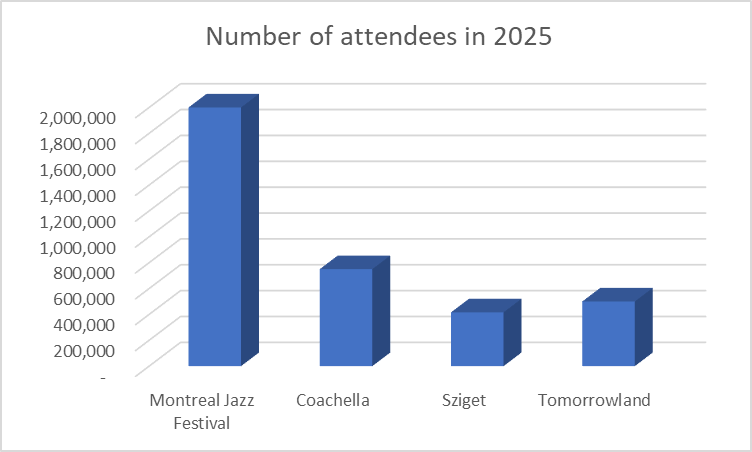
The genres of the festivals vary widely, from Electronic Dance Music and House, which define Tomorrowland, to Jazz at the Montreal International Jazz Festival. Meanwhile, Sziget and Coachella take a multi-genre approach (Skebaitė, 2025).
Current safety and security measures at music festivals:
Throughout the long history of outdoor music festivals, various security and safety-related issues have revealed themselves. These incidents resulted in standard safety and security regulations being enforced at these festivals. The regulations with specific details are accessible to all visitors on the festival’s official website. To illustrate some of the basic regulations, the visitor policy of Sziget Festival will be used (Sziget Cultural Management Ltd, 2024). As an example, to lower the chance of substance-related assaults taking place at the festival, weapons such as butterfly knives, firearms and throwing stars, as well as glass objects, outside alcohol and narcotics are prohibited: enforced by strict security checks (I. 3.). Furthermore, to ensure the visitors’ safety and reduce the risk of injuries, body surfing, mosh pits, and walls of death are banned during the concerts and repeat violators will be banned from the festival (II. 5.). Research conducted by safety expert Aldo Raineri and environmental expert Cameron Earl showed that crowd crushes, caused by the previously mentioned activities, are the one of the main causes of public health problems at outdoor music festivals (Raineri & Earl, 2005).
However, certain health and safety issues, as well as environmental concerns, receive less attention and recognition by event organisers. The study highlights that issues, such as hearing damage and poor fire safety, are not identified as critical public health risks (Raineri & Earl, 2005). Furthermore, these aspects are rarely mentioned on festival websites. In the following section, three HSE issues will be described in detail, along with possible solutions. The selected issues are noise pollution, fire and environmental pollution at these events.
The Description of and Counteractions against Three HSE issues:
Noise pollution
The primary reason people attend outdoor music festivals, which last multiple days, is to socialize and have an enjoyable experience (Mulder & Hitters, 2021). Beyond the live performances of the artists, the main factor contributing to this experience is the volume and quality of the music (Hanks, 2024).
Finding a balance in the volume while providing the highest quality of sound can be challenging. The music has to be loud enough to provide entertainment (Parnell & Sommer, 2018), however being exposed to loud sounds can result in temporary or permanent hearing loss, as well as tinnitus (NSW Ministry of Health, 2024). The latter is a condition when a ringing sound is heard by the affected without an external source (National Institute on Deafness and Other Communication Disorders, 2023).
Despite its widespread impact on health and quality of life, noise pollution has often been overlooked. A greater focus on noise pollution is essential, mainly because there is limited research and scientific evidence on this topic (Mercier, Luy, Hohmann, 2016). One of the most significant steps in investigating this concern was undertaken by Vlasta Mercier and her team, members of the Radiation Protection Division of the Swiss Federal Office of Public Health, with the participation of 600 volunteers.Their main goal was to calculate the exact sound exposition of the public during festivals. Another concern is that noise pollution has a negative medical effect not only on the attendees but also on the employees, performers and members of the nearby community (Hanks, 2024; Musicians’ Union, 2024).
The level of the music differs from genre to genre; for example, a 95 dB level, which measures the intensity or loudness of sound, is typical for an Indie concert, but rock concerts can reach the 125 dB level (10; Musicians’ Union, 2024). Due to the harmful effects on health and the frequent attendance at these events, the WHO’s general guideline states that the LAMax level cannot exceed 110 dB (World Health Organization, 1999). Furthermore, the European Directive, to protect the employees’ hearing, limited the noise exposure of workers to 87 dBA per 8-hour workday (Gelderblom & Tronstad, 2016). However, not every music festival has its noise-related regulations in place.
Highlighting the importance of earplugs is one possible method to overcome this issue. According to the supplier, earplugs reduce the amount of noise entering the ear canal, which results in less intensity and volume, but maintains the same quality of the sound (Loop Earplugs, n.d.). Meanwhile, they protect the outer hair cells, which are sensory cells in the inner ear that help make sounds clearer and stronger. Tomorrowland in Belgium serves as a notable example in this context. By providing free earplugs to the festival visitors, Tomorrowland takes action to mitigate sound-related health issues (Tomorrowland, 2025). Furthermore, this festival is in partnership with the company Loop, which is one of the leaders in the earplug industry (Tomorrowland, 2025). The design of the brand’s fashionable earplugs allows users to move and hold conversations freely. However, as the study conducted by Vlasta Mercier showed, the location of the earplugs at the festival area is crucial (Mercier, Luy, Hohmann, 2016). If these stations are far from the main areas, such as the stages and catering area, visitors overlook them.
Another tool used to reduce health issues caused by noise pollution is the installation of noise-cancelling equipment (Precon Events, 2024). As a result of the rapid technological advancement, different electronic devices are available for event organisers to lower excessive noise levels. Noise-cancelling microphones capture sounds while reducing unnecessary background noise. Noise-cancelling headphones help protect employees in loud environments by reducing harmful background noise while allowing important sounds, such as speech and safety signals, to be heard, thereby preventing hearing damage without compromising communication (Musicians’ Union, 2024). A further example are the measurement stations of the Data Service at Coachella to monitor and manage sound levels (SofTech, Inc., 2023).
Fire
Fire risk is one of the most widely recognised HSE issues not only at outdoor music festivals, but across the entire event industry. As this risk can be anticipated, event organisers comply with fire-related regulations to prevent the chance of fire situations. These regulations include the prohibition of flammable materials and gas cylinders within the festival area, as well as the placement of fire extinguishers in every building, tent, stage, catering and commercial unit across the event site (3.3.1) (Sziget Cultural Management Ltd, 2024; Sziget Cultural Management Ltd, 2024). Furthermore, the Integrated Emergency Management Documentation of Sziget Festival emphasises the commitment to fire safety through the constant presence of fire trucks and an on-site fire commander, as well as the Rescue Plan presented by the National Ambulance Service (Sziget Cultural Management Ltd., 2024. The document additionally highlighted the presence of an Operational Control Centre, tasked with coordinating different units during a fire.
Despite these safety measures, incidents such as the massive fire at Belgium’s Tomorrowland, which started on 13th of July 2025, continue to occur (De Ruiter, 2025). Two days before the festival began, 1000 staff members had to be evacuated, and the root cause is still unclear (CNN, 2025). Different reasons contribute to fire incidents at these festivals; however, the focus of this discussion will be on material and electrical maintenance, as well as the role of heat and smoking habits.
The decoration of the stages and main areas can result in fire if improperly managed. The materials used for creating unique designs for the performances include polystyrene, plywood, polyurethane foam, sealant, wood glue and modelling paste, due to their workability and suitability for shaping and application (VRT NWS, 2025). However, the combination of these elements is highly flammable, and even a small spark, can cause a fire. To prevent such incidents, festivals such as Coachella, as it is required by the laws and regulations within the state of California, use fire-retardant paint, a chemical treatment that reduces the flammability of materials (Sew What? Inc., n.d.). Therefore, the likelihood of fire is reduced. Furthermore, the inadequate maintenance of electrical cables leads to fire. The regular inspection of cables and electrical machines is essential to detect technical faults and resolve potential issues. Another solution to prevent damaged cables, and with that, a fire, is the installation of protective coverings (Government of South Australia, 2017). As a result, the outer layer of the cables will not be damaged by footsteps and vehicles.

Government of South Australia, 2017
Due to the increasing number of heat waves and the decreased precipitation resulting from climate change, drought conditions are becoming a bigger issue in the natural environment of festivals. Even though the increased temperature does not directly cause fire, with other factors such as the improper disposal of cigarettes, it can increase the likelihood of fire hazards. The case of the Boomtown Fair Fire, which took place in 2016, points out the danger that the combination of heat and smoking can bring (BBC News, 2016). This fire destroyed 80 cars before the firefighters and safety staff extinguished it. Festivals, such as Sziget, allow visitors to smoke in open areas, but using alternative smokeless alternatives such as nicotine pouches and patches could be a solution for this problem (Sziget Cultural Management Ltd, 2024; Musomuso, 2022).
Environmental
Festivals offer a perfect opportunity for entertainment and relaxation; as a result, during these events, festival attendees often care less about their impact on the natural environment. Littering, leaving plastic items behind, and the CO₂ emissions from travelling to these occasions are a few examples of the environmentally damaging activities associated with outdoor music festivals. According to The Post (Athens, OH) newspaper, approximately 1,600 tons of waste are produced each year during the two weekends of Coachella, with a recycling rate of only 20% (Hopkins, 2025). Furthermore, the study conducted by Censuswide draws attention to the role of fast fashion trends in this issue. This study revealed, with the help of 2000 participants, that roughly 7,5 million single-use outfits are worn at music festivals, such as Glastonbury and Coachella (TFL Media, Inc., 2019).
Some festivals, including Sziget and Coachella, have an ongoing sustainability program to reduce their environmental footprint (Goldenvoice, 2025; Sziget Festival, 2025). However, as the website of Coachella highlights, without the engagement of the visitors, these efforts can’t reach their desired environmental effect. Two green campaigns are outlined in the following.
Out of Coachella’s sustainability initiatives, the “Carpoolchella” program stands out as a key initiative. The idea is simple: participants who take more than four passengers with them and place a visible CARPOOLCHELLA sign on their car are able to win exclusive prizes (Goldenvoice, LLC, 2025). The festival randomly selected a lifetime VIP pass, VIP upgrades, guest “backstage” passes, and different premium vouchers among the winners. This campaign not only attracts the festival visitors with high-value gifts, but also benefits the environment. This challenge encourages festival attendees to choose carpooling, and with fewer cars arriving at the festival site, the CO₂ emissions are radically reduced.
As the vision statement of Sziget’s sustainability policy states, being environmentally responsible in every aspect of the festival’s operations is a prominent goal of the organisers (Sziget Festival, 2025). Encouraging visitors to arrive by public transport or bicycle, or to choose from the wide range of vegetarian and vegan food options, reflects the commitment of Sziget to a greener festival experience. However, the Green Camping Initiative is one of the most popular. Not only does this idea reduce the 7000-kilogram plastic waste that is generated by the abandoned tents every year, but the participants can also support a good cause. The tents, left at the Camping Recycling Zones, are donated to charity (Goldenvoice, LLC, 2025). Furthermore, for the international festival attendees, it is a convenient way to leave behind their tents and equipment responsibly, without the need to transport them back home.
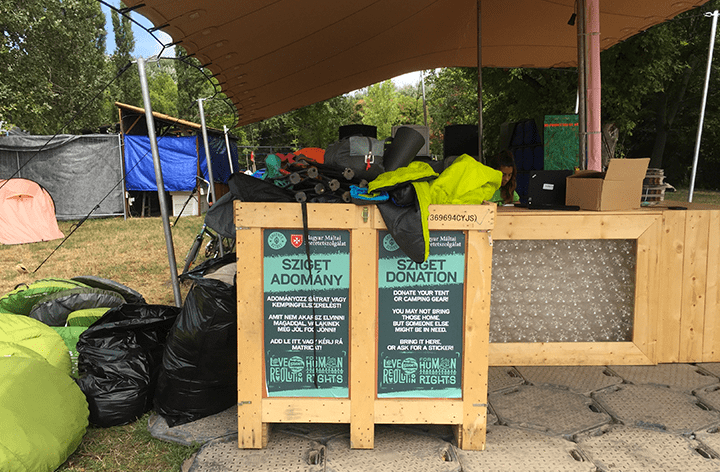
Sziget Festival, 2019
Conclusion:
As outdoor music festivals differ in size and genre, one thing is common among them: the safety and security threats that arise from the combination of crowded places, alcohol consumption, and the atmosphere created by live music. This paper addresses the issues of noise pollution, poor fire maintenance, and environmental pollution, along with possible solutions, such as Loop earplugs, alternative smoking items, and green campaigns, including ‘Carpoolchella’ and the Green Camping Initiative. The paper examines the current situation and highlights the significance of HSE issues in the outdoor music festival sector.
Bibliography:
BBC News. (2016, August 15). Boomtown Fair fire: Car park blaze ’caused by cigarette’. https://www.bbc.com/news/uk-england-hampshire-37083532
Bráder, Á. (2025, August 13). 416,000 attend Sziget as renewal efforts reverse declining trend. Hungarian Conservative. https://www.hungarianconservative.com/articles/culture_society/sziget-festival-renewal-attendance-growth-2025/
CNN. (2025, July 16). Tomorrowland festival Belgium fire: ‘All it takes is a small spark’. https://edition.cnn.com/2025/07/16/europe/tomorrowland-festival-belgium-fire-intl-latam
Crompton, J. L., & McKay, S. L. (1997). Motives of visitors attending festival events. Annals of Tourism Research, 24(2), 425–439 https://course.festivals.coplacdigital.org/wp-content/uploads/2016/01/crompton.pdf
De Ruiter, E. (2025, July 18). Belgium’s Tomorrowland festival opens after massive fire destroyed main stage. Euronews. https://www.euronews.com/culture/2025/07/18/belgiums-tomorrowland-festival-opens-after-massive-fire-destroyed-main-stage
Gelderblom, F. B., & Tronstad, T. V. (2016). Sound exposure during outdoor music festivals. Noise & Health, 18(83), 220–228. https://pmc.ncbi.nlm.nih.gov/articles/PMC5187664/#sec1-1
Goldenvoice. (2025). Sustainability. Coachella. https://www.coachella.com/sustainability
Goldenvoice, LLC. (2025, April). 2025 Carpoolchella Secret Spotter Weekend One: Sweepstakes rules and regulations. Coachella. https://www.coachella.com/carpoolchella-weekend-1-rules
Government of South Australia. (2017). Electrical safety at festivals and events. https://www.unley.sa.gov.au/files/assets/public/v/1/events-amp-facilities/161213-electrical-safety-at-festivals-and-events-a5.pdf
Hanks, C. (2024, September 13). Understanding noise pollution: A guide for event planners. Event Noise Management. https://www.eventnoisemanagement.co.uk/post/understanding-noise-pollution-a-guide-for-event-planners
Hopkins, A. (2025, April 22). Coachella sustainability falls flat without audience participation. The Post. https://www.thepostathens.com/article/2025/04/coachella-environmental-impacts-sustainability
Loop Earplugs. (n.d.). Earplugs for festivals. https://www.loopearplugs.com/pages/earplugs-for-festivals
Mercier, V., Luy, D., & Hohmann, B. W. (2016). The sound exposure of the audience at a music festival. Noise & Health, 5(19), 51–58. https://journals.lww.com/nohe/fulltext/2003/05190/the_sound_exposure_of_the_audience_at_a_music.5.aspx
Mulder, M., & Hitters, E. (2021). Visiting pop concerts and festivals: Measuring the value of an integrated live music motivation scale. Cultural Trends, 30(4), 355–375. https://culturecase.org/research/2025/07/six-motivations-attending-live-music/
Musicians’ Union. (2024, February 1). Hearing protection. https://musiciansunion.org.uk/health-safety-wellbeing/health-and-safety/key-health-and-safety-issues/hearing-health/hearing-protection
Musicians’ Union. (2024, July 16). UK noise regulations. https://musiciansunion.org.uk/health-safety-wellbeing/health-and-safety/key-health-and-safety-issues/hearing-health/uk-noise-regulations
Musomuso. (2022, November 29). How fire hazards are affecting festivals in the UK — And what’s being done about them. https://musomuso.com/news/how-fire-hazards-are-affecting-festivals-in-the-uk-and-whats-being-done-about-them
National Institute on Deafness and Other Communication Disorders. (2023, February). Tinnitus: What is tinnitus? U.S. Department of Health & Human Services. https://www.nidcd.nih.gov/health/tinnitus#1
NSW Ministry of Health. (2024, October). Guidelines for music festival event organisers: Music festival harm reduction. https://www.health.nsw.gov.au/aod/Publications/music-festival-guidelines.pdf
Parnell, J., & Sommer, R. (2018). Setting noise objectives for outdoor music festivals in rural locations. Acoustics 2018. https://www.researchgate.net/publication/329023521_Setting_noise_objectives_for_outdoor_music_festivals_in_rural_locations
Perron-Brault, A., de Grandpré, F., Legoux, R., & Dantas, D. C. (2020). Popular music festivals: An examination of the relationship between festival programs and attendee motivations. Journal of Destination Marketing & Management, 18, 100472. https://www.sciencedirect.com/science/article/abs/pii/S2211973620300374
Precon Events. (2024, September 17). How to soundproof: 7 ways to stop noise pollution at events. https://preconevents.com/how-to-soundproof-7-ways-to-stop-noise-pollution-at-events/#:~:text=Use%20Acoustic%20Barriers,such%20as%20concerts%20or%20festivals
Raineri, A., & Earl, C. (2005). Crowd management for outdoor music festivals. Journal of Occupational Health and Safety – Australia and New Zealand, 21(3), 205–215. https://www.researchgate.net/publication/236901272_Crowd_management_for_outdoor_music_festivals
Robertson, A. (2023, July 6). How big is a music festival? FestivalPro. https://www.festivalpro.com/festival-management/2788/news/2023/7/6/How-Big-is-a-Music-Festival.html#:~:text=Small%20scale%20festivals%20typically%20have,thousand%20visitors%20are%20in%20attendance
Sew What? Inc. (n.d.). Fire retardancy requirements in California. In Flame Retardancy. https://sewwhatinc.com/resources/flame-retardancy/fire-retardancy-requirements-california/
Skebaitė, A. (2025, July 29). The best music festivals around the world: A genre guide (Updated for 2025). Saily. https://saily.com/blog/best-music-festivals-in-the-world/
SofTech, Inc. (2023, May). Noisy music festivals: The Coachella case. https://www.softechweb.it/wp-content/uploads/2023/05/SOFTECH_Coachella-case-1.pdf
Sziget Cultural Management Ltd. (2024, April). Integrated emergency management documentation: Visitor extract. https://szigetfestival.com/wp-content/uploads/2024/04/Biztonsagi_tuzriado_terv_SZIGET_2025_latogatoknak_angol.pdf
Sziget Cultural Management Ltd. (2024, September). Sziget Festival visitor policy 2024. https://szigetfestival.com/wp-content/uploads/2024/09/sziget_visitor_policy_2024-2.pdf
Sziget Festival. (2025). Green Sziget. https://szigetfestival.com/en/greensziget
Sziget Festival. (2025). Sustainability policy. https://szigetfestival.com/en/sustainability-policy
TFL Media, Inc. (2019, July 16). Consumers will spend more than $3 billion on single-use outfits this summer, alone. The Fashion Law. https://www.thefashionlaw.com/single-use-outfits-outfits-account-for-hundreds-of-millions-of-dollars-in-revenue-each-year/
The World or Bust. (2025, July 26). Biggest music festival in the world. https://www.theworldorbust.com/biggest-music-festival-in-the-world/#Top_5_largest_music_festivals_by_attendance_in_2025
Tomorrowland. (2025). We care a lot. https://belgium.tomorrowland.com/en/practical/we-care-a-lot/
Tomorrowland. (2025, May 27). Taking festivals higher: Loop™ becomes Tomorrowland’s official earplug partner worldwide. Tomorrowland Store. https://tomorrowlandstore.press.tomorrowland.com/taking-festivals-higher-loop-becomes-tomorrowlands-official-earplug-partner-worldwide#:~:text=%E2%80%8BThis%20year’s%20partnership%20welcomes,this%20on%20a%20global%20scale.%E2%80%9D
VRT NWS. (2025, July 17). Tomorrowland: Fire on main stage—“All it takes is a small spark”. https://www.vrt.be/vrtnws/en/2025/07/17/tomorrowland-fire-all-it-takes-is-a-small-spark/World Health Organization. (1999). Guidelines for community noise (WHO Reference Number: a68672). https://www.who.int/publications/i/item/a68672

 Home | Centuria Study Association
Leave a comment